
Topic · Access control
Access control
Doors, readers, controllers and locks: how they talk to each other, and how to find which link has failed.
How it fits together
Every access-controlled door is a chain: a credential is read, the reader passes it to a controller, the controller decides, and an output releases the lock. The door contact and exit button report back. A fault at any link looks the same to the person at the door: it does not open.
The controller’s event log is the best place to start. Whether it shows “granted”, “denied” or nothing at all tells you which half of the chain to look at, before anyone opens a ceiling tile.
What to check first
Read the event first
Granted but locked points to the lock, its power or the relay. Denied points to the card, its format or the access rules. No event points to the reader wiring or settings.
Know your card formats
A card read in the wrong format produces a different number. Enrol cards by presenting them at an enrolment reader rather than typing the printed number where you can.
Respect escape routes
Doors on escape routes must release on fire alarm and have a manual release as the local code and fire authority require. Never bypass these to fix a fault.
Document lock types
Record whether each door is fail-safe (magnetic lock, powered to lock) or fail-secure (strike, powered to unlock). It decides how the relay is wired and what happens on power loss.
Free · runs in your browser
Calculators and labs
Access-control door logic
Work through door states and the events a controller reports.
Reader wiring: Wiegand and OSDP
Match Wiegand and OSDP reader conductors to controller terminals.
Power budgeting
Check lock power and battery backup hours.
Labs are simulations and planning estimates, not real hardware. Check datasheets, the site and the applicable standard before you buy or install.
From the library · paid
Books on Access control
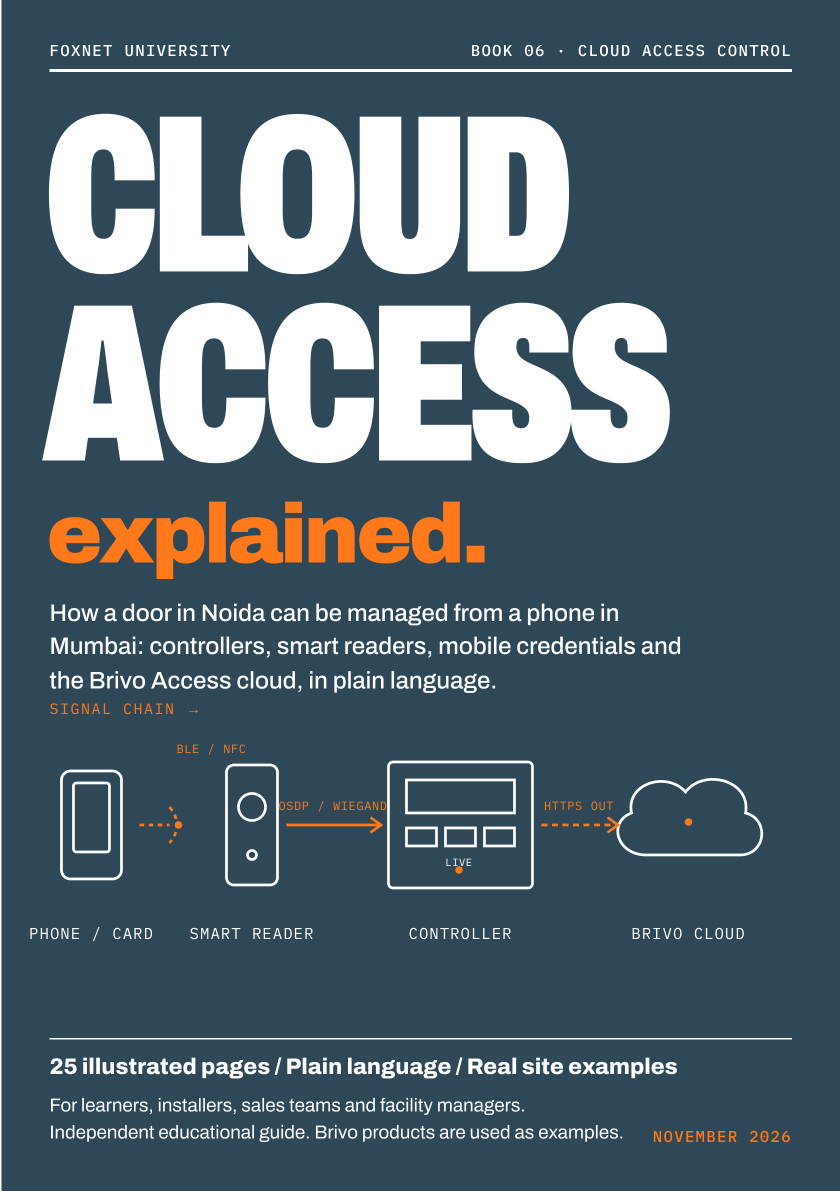
Cloud Access Control Explained
How a door in Noida can be managed from a phone in Mumbai: controllers, smart readers, mobile credentials and the Brivo Access cloud
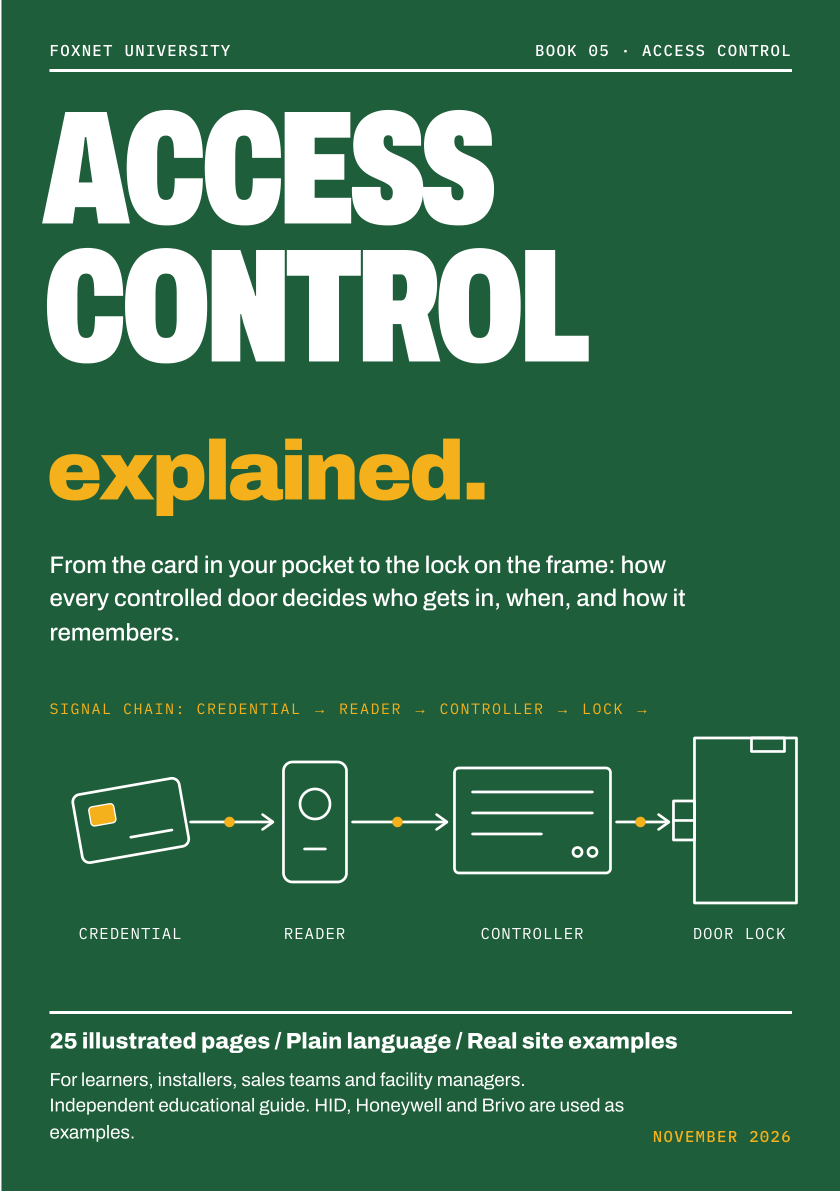
Access Control Explained
From the card in your pocket to the lock on the frame: how every controlled door decides who gets in, when, and how it remembers

HID Cards Explained
From the plastic card in your wallet to the technology that opens a secure door

Biometrics Explained
How a fingerprint or a face becomes a few kilobytes of numbers that open a door or mark attendance, and how to choose, install and look after the devices in Indian conditions
Training and engineer support
Get help from Foxnet
Get trained
Foxnet-led sessions on access control design, reader and lock wiring, card formats and commissioning.
Book an engineer
Book a Foxnet engineer to go through event logs and settings remotely, or to test readers, locks and power on site.
Ask an engineer
Send a question with photos or logs and get a written answer from a Foxnet engineer, or a short call.
Foxnet-led training is delivered by Foxnet engineers. It is not official OEM-authorised training and does not lead to a manufacturer certification.
Foxnet Securitas
Need the work done?
Foxnet designs, installs and maintains these systems for sites across India.
- Access control systemsCard, biometric and cloud access control design and installation.
- Visitor managementQR and OTP check-in, badges and lobby workflows.
Other topics
CCTV and video surveillance
Practical guides for IP cameras, NVRs and VMS: fault-finding steps that work on site, and the arithmetic behind storage and bandwidth.
WIN-PAK access control
Practical help for engineers and administrators looking after WIN-PAK sites: communication, controllers and the database that ties them together.
Fire alarm systems
How fire detection and alarm systems are put together, what the panel is telling you, and what a facility team’s job is — and is not.
Building management systems (BMS)
How a BMS talks to chillers, air handlers, pumps and meters, and how to find out why a point has stopped updating.
Public address and voice alarm
Paging, background music and evacuation messages: how PA and voice alarm systems are built, and where the life-safety line is drawn.
IT networking for security systems
The network under CCTV, access control and BMS: PoE power, IP addressing, VLANs, bandwidth and cabling done properly.
Talk to an engineer
Not sure which service fits?
Tell us what you are working on. A Foxnet engineer will point you to the right session, book or request — or tell you honestly if you do not need one.