
Topic · PA and voice alarm
Public address and voice alarm
Paging, background music and evacuation messages: how PA and voice alarm systems are built, and where the life-safety line is drawn.
How it fits together
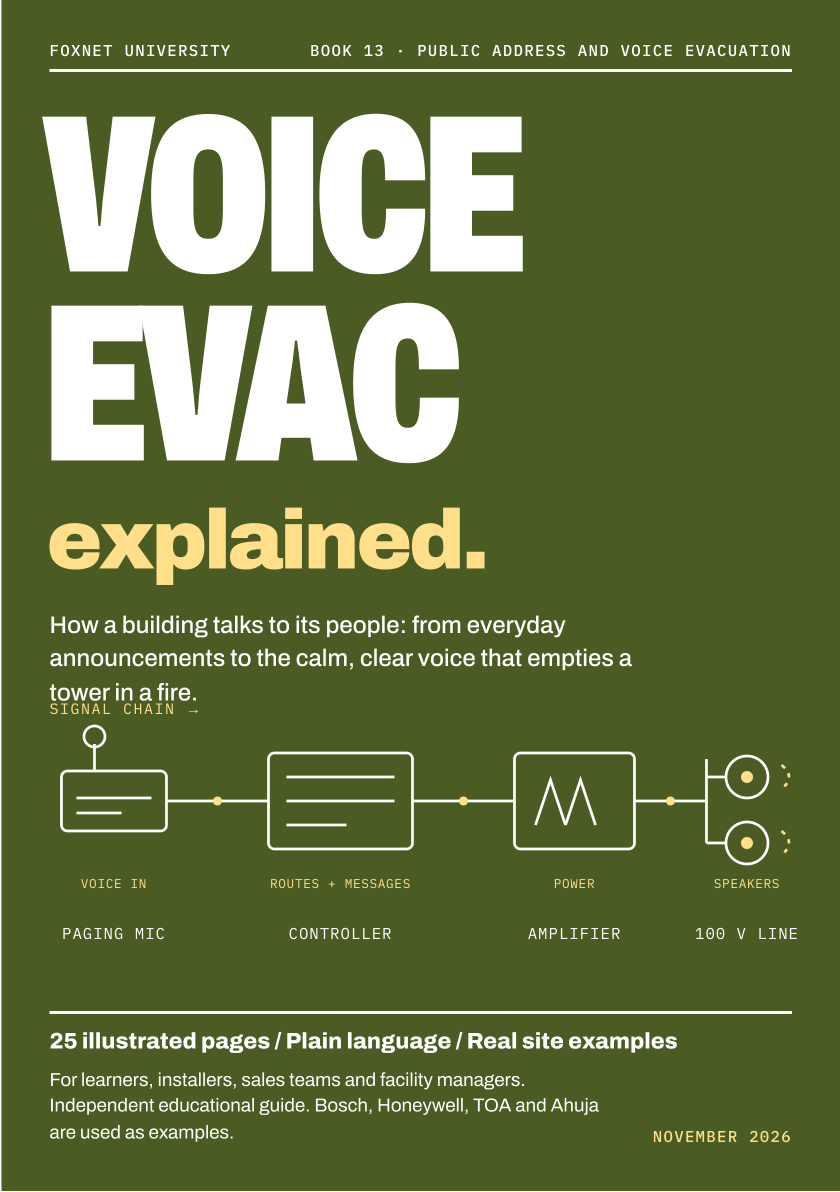
A public address system takes audio sources (paging microphones, background music, pre-recorded messages), routes them to zones, amplifies them and drives loudspeakers. Most commercial systems use 100 V line distribution: each loudspeaker has a transformer tapped at a chosen wattage, so many speakers can share one long cable run from the amplifier.
A voice alarm (voice evacuation) system does the same job for life safety: when the fire alarm signals, it broadcasts evacuation or alert messages by zone, overriding paging and music, and it must monitor its own amplifiers, lines and power. Many sites use one system for both, which means the everyday PA is also a life-safety system.
Where a system is used for evacuation, its design, changes, testing and maintenance must be done by qualified people to the standard the project was designed to (for example EN 54-16 and EN 54-24 where specified) and the conditions of the fire NOC, coordinated with the fire alarm maintainer.
What a facility team should do
Know which system you have
Find out whether your PA is also the voice alarm. If it is, treat faults, disconnections and speaker changes as life-safety issues.
Report fault indications
Line, amplifier and power faults on a voice alarm controller mean a zone may not hear an evacuation message. Record and report them to the maintainer.
Do not add speakers to a line
Adding or re-tapping speakers changes the load on an amplifier channel and, on a monitored system, its line supervision. Changes go through the system maintainer.
Keep messages current
Make sure recorded messages, zone names and paging permissions match the building today, in the languages your occupants understand.
Free · runs in your browser
Calculators and labs
Labs are simulations and planning estimates, not real hardware. Check datasheets, the site and the applicable standard before you buy or install.
From the library · paid
Books on PA and voice alarm
Training and engineer support
Get help from Foxnet
Get trained
Foxnet-led sessions for operators: paging, zones, scheduled messages and responding to fault indications.
Book an engineer
Ask an Engineer can explain a fault indication or a design question. Foxnet’s PA team can survey, extend and maintain PA systems.
Ask an engineer
Send a question with photos or logs and get a written answer from a Foxnet engineer, or a short call.
Foxnet-led training is delivered by Foxnet engineers. It is not official OEM-authorised training and does not lead to a manufacturer certification.
Foxnet Securitas
Need the work done?
Foxnet designs, installs and maintains these systems for sites across India.
- Public address systemsPaging, background music and zoned announcements for sites and campuses.
- Sound technologyProfessional audio for boardrooms and auditoriums.
Other topics
CCTV and video surveillance
Practical guides for IP cameras, NVRs and VMS: fault-finding steps that work on site, and the arithmetic behind storage and bandwidth.
Access control
Doors, readers, controllers and locks: how they talk to each other, and how to find which link has failed.
WIN-PAK access control
Practical help for engineers and administrators looking after WIN-PAK sites: communication, controllers and the database that ties them together.
Fire alarm systems
How fire detection and alarm systems are put together, what the panel is telling you, and what a facility team’s job is — and is not.
Building management systems (BMS)
How a BMS talks to chillers, air handlers, pumps and meters, and how to find out why a point has stopped updating.
IT networking for security systems
The network under CCTV, access control and BMS: PoE power, IP addressing, VLANs, bandwidth and cabling done properly.
Talk to an engineer
Not sure which service fits?
Tell us what you are working on. A Foxnet engineer will point you to the right session, book or request — or tell you honestly if you do not need one.