
Topic · BMS
Building management systems (BMS)
How a BMS talks to chillers, air handlers, pumps and meters, and how to find out why a point has stopped updating.
How it fits together
A building management system (BMS) monitors and controls building services: chillers, air handling units, pumps, ventilation, lighting and energy meters. A supervisor (head-end) talks to field controllers, and the controllers talk to equipment, often through protocol gateways.
Two protocols do most of the work in Indian buildings. BACnet (BACnet/IP on the network, BACnet MS/TP on RS-485) is common between BMS controllers. Modbus (Modbus TCP on the network, Modbus RTU on RS-485) is common on energy meters, VFDs, DG controllers and packaged equipment. When a point goes stale, the cause is usually wiring, serial settings, addressing or register mapping.
What to check first
Read before you write
Diagnose with read-only requests. Writing a register on live plant can start, stop or change equipment. Writes need the plant owner’s permission and a safe plan.
Keep a points list
For every integrated device, record protocol, address, serial settings, IP, register map version and scaling. Most integration faults are found by comparing against it.
One change at a time
Change one setting, test, and record it. Changing baud rate, parity and address together hides which one fixed or broke the link.
Separate the networks
Put BMS IP devices on their own VLAN or subnet with planned addresses, and keep serial trunks as daisy chains with termination only at the ends.
Free · runs in your browser
Calculators and labs
Labs are simulations and planning estimates, not real hardware. Check datasheets, the site and the applicable standard before you buy or install.
From the library · paid
Books on BMS
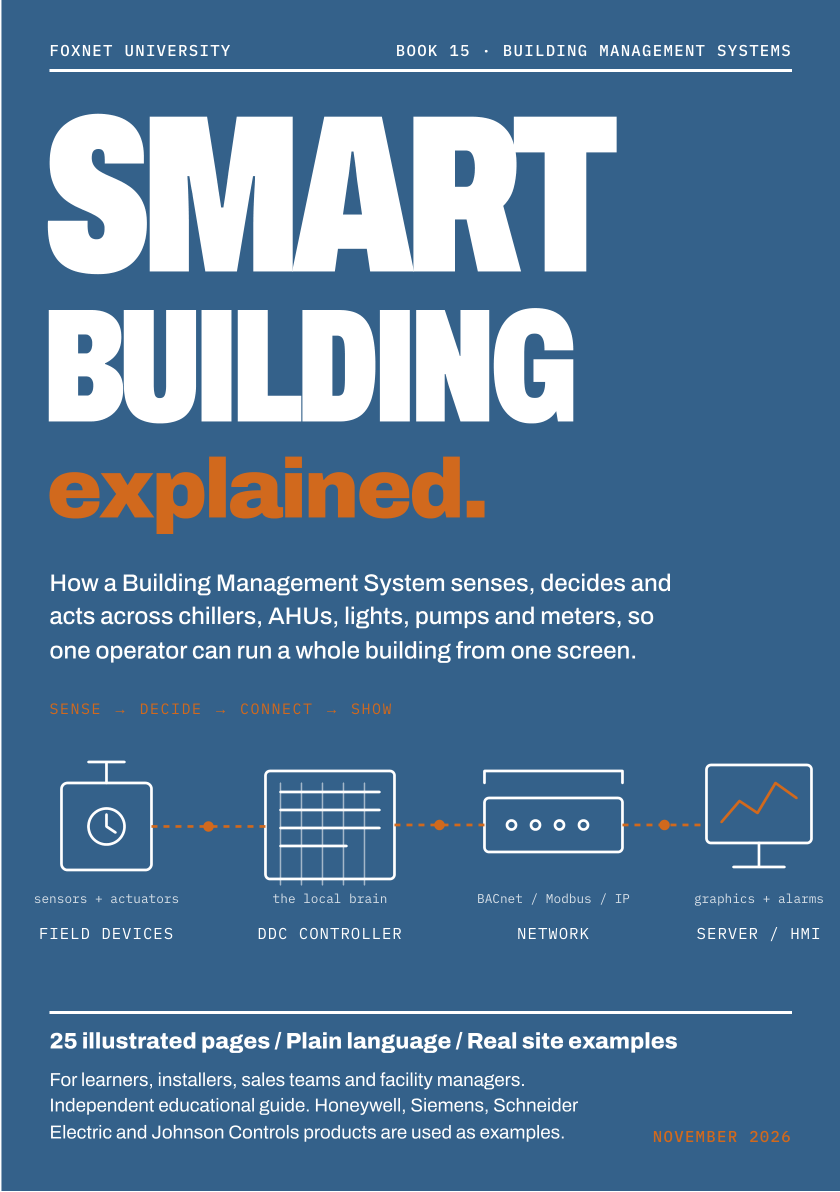
BMS & Smart Buildings Explained
How a Building Management System senses, decides and acts across chillers, AHUs, lights, pumps and meters, so one operator can run a whole building from one screen

Integration & PSIM Explained
How CCTV, access control, fire and intrusion systems are wired and programmed to act as one, so a guard sees the event, the video and the next step together
Training and engineer support
Get help from Foxnet
Get trained
Foxnet-led sessions on BMS integration basics, BACnet and Modbus communication, and working safely on live systems.
Book an engineer
A Foxnet engineer can review a points list, gateway settings and communication logs with you remotely, or attend site to test RS-485 trunks.
Ask an engineer
Send a question with photos or logs and get a written answer from a Foxnet engineer, or a short call.
Foxnet-led training is delivered by Foxnet engineers. It is not official OEM-authorised training and does not lead to a manufacturer certification.
Foxnet Securitas
Need the work done?
Foxnet designs, installs and maintains these systems for sites across India.
- Command and control centresVideo walls, VMS and integration of video, access, fire and BMS alarms.
- IT infrastructure and structured cablingCat6/Cat6A and fibre cabling, racks, switching and server rooms.
Other topics
CCTV and video surveillance
Practical guides for IP cameras, NVRs and VMS: fault-finding steps that work on site, and the arithmetic behind storage and bandwidth.
Access control
Doors, readers, controllers and locks: how they talk to each other, and how to find which link has failed.
WIN-PAK access control
Practical help for engineers and administrators looking after WIN-PAK sites: communication, controllers and the database that ties them together.
Fire alarm systems
How fire detection and alarm systems are put together, what the panel is telling you, and what a facility team’s job is — and is not.
Public address and voice alarm
Paging, background music and evacuation messages: how PA and voice alarm systems are built, and where the life-safety line is drawn.
IT networking for security systems
The network under CCTV, access control and BMS: PoE power, IP addressing, VLANs, bandwidth and cabling done properly.
Talk to an engineer
Not sure which service fits?
Tell us what you are working on. A Foxnet engineer will point you to the right session, book or request — or tell you honestly if you do not need one.