
Topic · Fire alarm
Fire alarm systems
How fire detection and alarm systems are put together, what the panel is telling you, and what a facility team’s job is — and is not.
How it fits together
A fire alarm system detects fire (smoke, heat or flame detectors and manual call points), decides at the control panel, and warns people (sounders, beacons, voice alarm) while signalling other systems: releasing doors, stopping air handling units, recalling lifts and calling the fire brigade where connected.
Conventional systems wire devices in zones on radial circuits, so the panel knows the zone but not the device. Addressable systems wire devices on a loop, each with its own address, so the panel names the exact device. Loops are usually wired out and back to the panel, with isolators so a single short circuit takes out only a section.
Fire alarm systems are life-safety systems. Their design, installation, modification, servicing and certification must be done by qualified, authorised people following the National Building Code of India (Part 4), the standard the project was designed to (for example IS 2189) and the conditions of the fire NOC.
What a facility team should do
Treat every fault as urgent
A fault or disablement means part of the building may not be protected. Record it in the log book, tell the responsible person and call the fire alarm maintainer.
Keep the log book
Record alarms (real and false), faults, disablements, tests and service visits with date, time and who did what. Inspectors and maintainers rely on it.
Never leave zones disabled
Disabling a zone for work must be planned, authorised, recorded and reversed as soon as the work ends, with extra fire watch if your procedure requires it.
Report false alarms
Repeated false alarms from one device have a cause (dust, steam, cooking, wrong detector type). Report the device address and the conditions; do not cover or remove detectors.
Free · runs in your browser
Calculators and labs
Fire alarm fault-finding
A classroom simulation: read panel indications and choose the likely fault. Not a procedure for a live panel.
Power budgeting
See how a standby battery estimate is built. The panel maker’s calculation and the standard decide the real figure.
Labs are simulations and planning estimates, not real hardware. Check datasheets, the site and the applicable standard before you buy or install.
From the library · paid
Books on Fire alarm
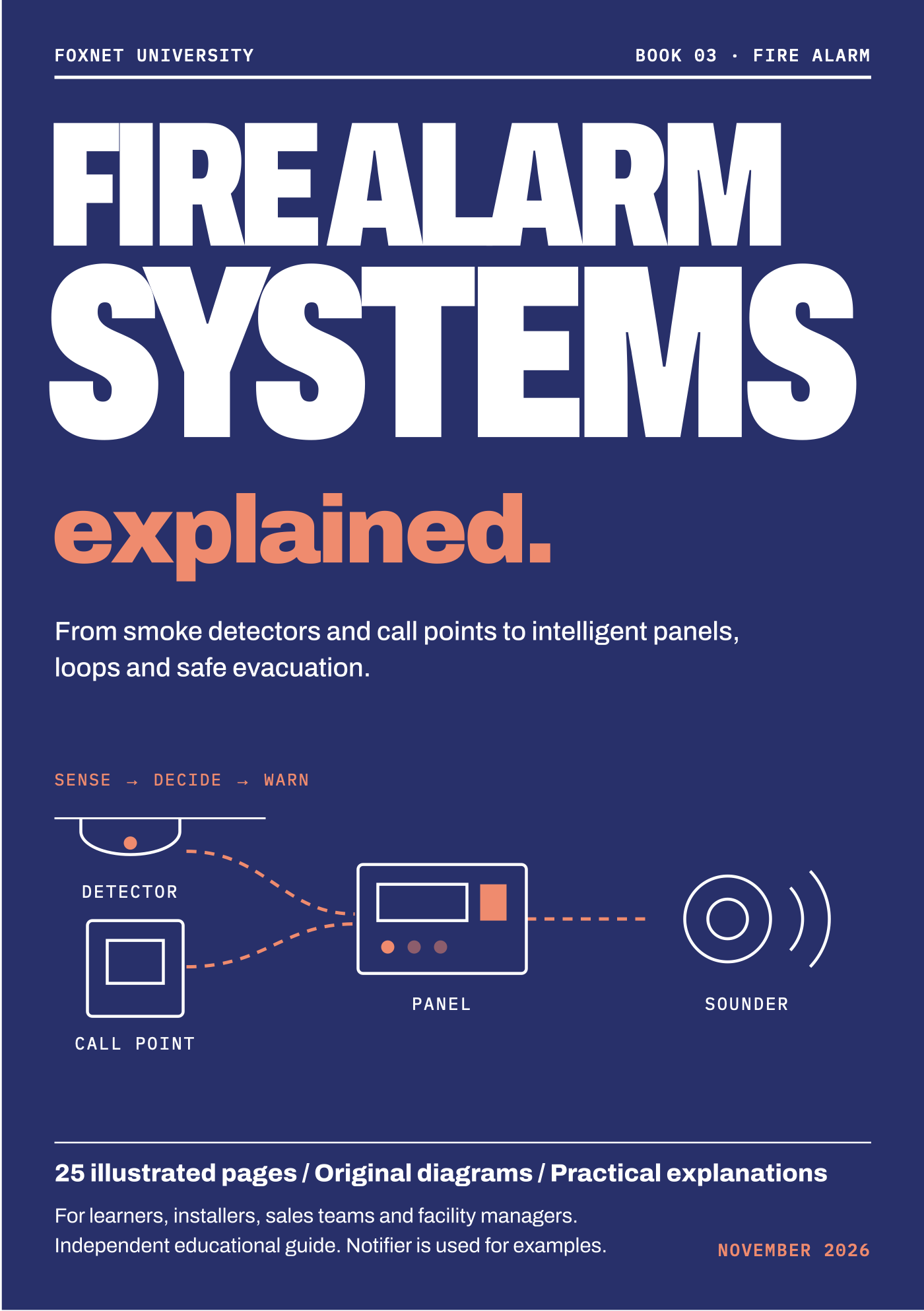
Fire Alarm Systems Explained
From smoke detectors and call points to intelligent panels, loops and safe evacuation
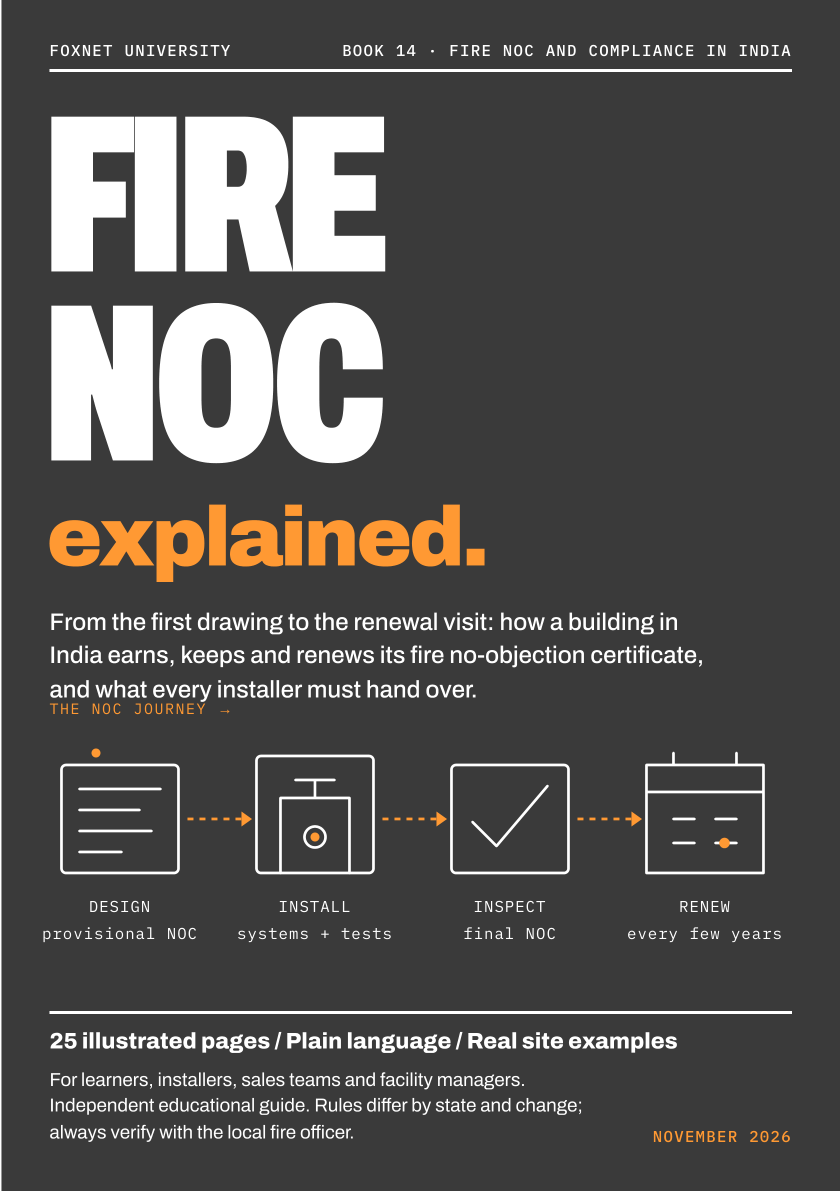
Fire NOC & Compliance in India
From the first drawing to the renewal visit: how a building in India earns, keeps and renews its fire no-objection certificate, and what every installer must hand over
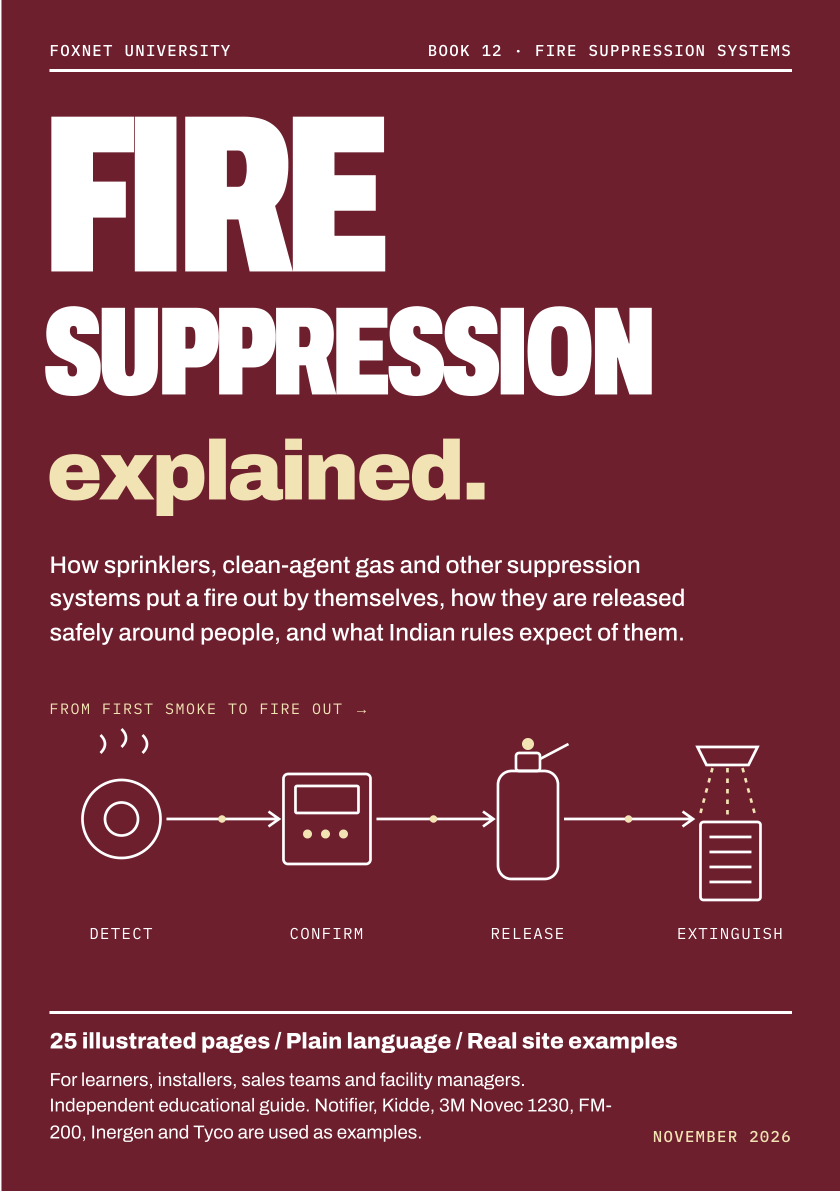
Fire Suppression Explained
How sprinklers, clean-agent gas and other suppression systems put a fire out by themselves, how they are released safely around people, and what Indian rules expect
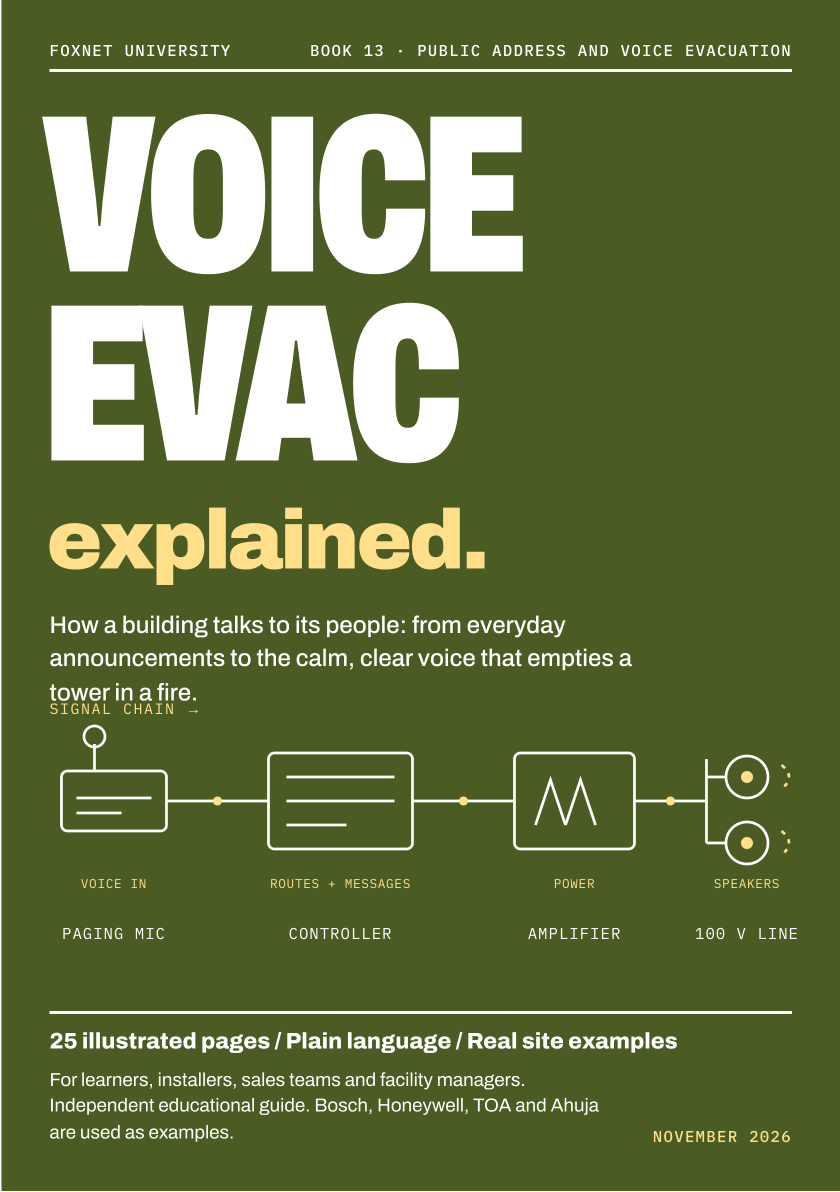
PA & Voice Evacuation Explained
How a building talks to its people: from everyday announcements to the calm, clear voice that empties a tower in a fire
Training and engineer support
Get help from Foxnet
Get trained
Foxnet-led awareness sessions for facility and security teams: reading the panel, keeping records and responding to alarms and faults.
Book an engineer
Foxnet’s fire team can inspect, service and maintain fire alarm systems under an AMC. Ask an Engineer can explain a panel indication before you call it out.
Ask an engineer
Send a question with photos or logs and get a written answer from a Foxnet engineer, or a short call.
Foxnet-led training is delivered by Foxnet engineers. It is not official OEM-authorised training and does not lead to a manufacturer certification.
Foxnet Securitas
Need the work done?
Foxnet designs, installs and maintains these systems for sites across India.
- Fire alarm systemsFire alarm installation and AMC by Foxnet’s fire team, with fire NOC support.
Other topics
CCTV and video surveillance
Practical guides for IP cameras, NVRs and VMS: fault-finding steps that work on site, and the arithmetic behind storage and bandwidth.
Access control
Doors, readers, controllers and locks: how they talk to each other, and how to find which link has failed.
WIN-PAK access control
Practical help for engineers and administrators looking after WIN-PAK sites: communication, controllers and the database that ties them together.
Building management systems (BMS)
How a BMS talks to chillers, air handlers, pumps and meters, and how to find out why a point has stopped updating.
Public address and voice alarm
Paging, background music and evacuation messages: how PA and voice alarm systems are built, and where the life-safety line is drawn.
IT networking for security systems
The network under CCTV, access control and BMS: PoE power, IP addressing, VLANs, bandwidth and cabling done properly.
Talk to an engineer
Not sure which service fits?
Tell us what you are working on. A Foxnet engineer will point you to the right session, book or request — or tell you honestly if you do not need one.